MBBR Media · Technical Reference & Specifications
Principle, technical core, product advantages and the full K1–K5 / PE series specifications of MBBR moving bed biofilm media.
 ← Back to MBBR Media
Principle, technical core, product advantages and the full K1–K5 / PE series specifications of MBBR moving bed biofilm media.
← Back to MBBR Media
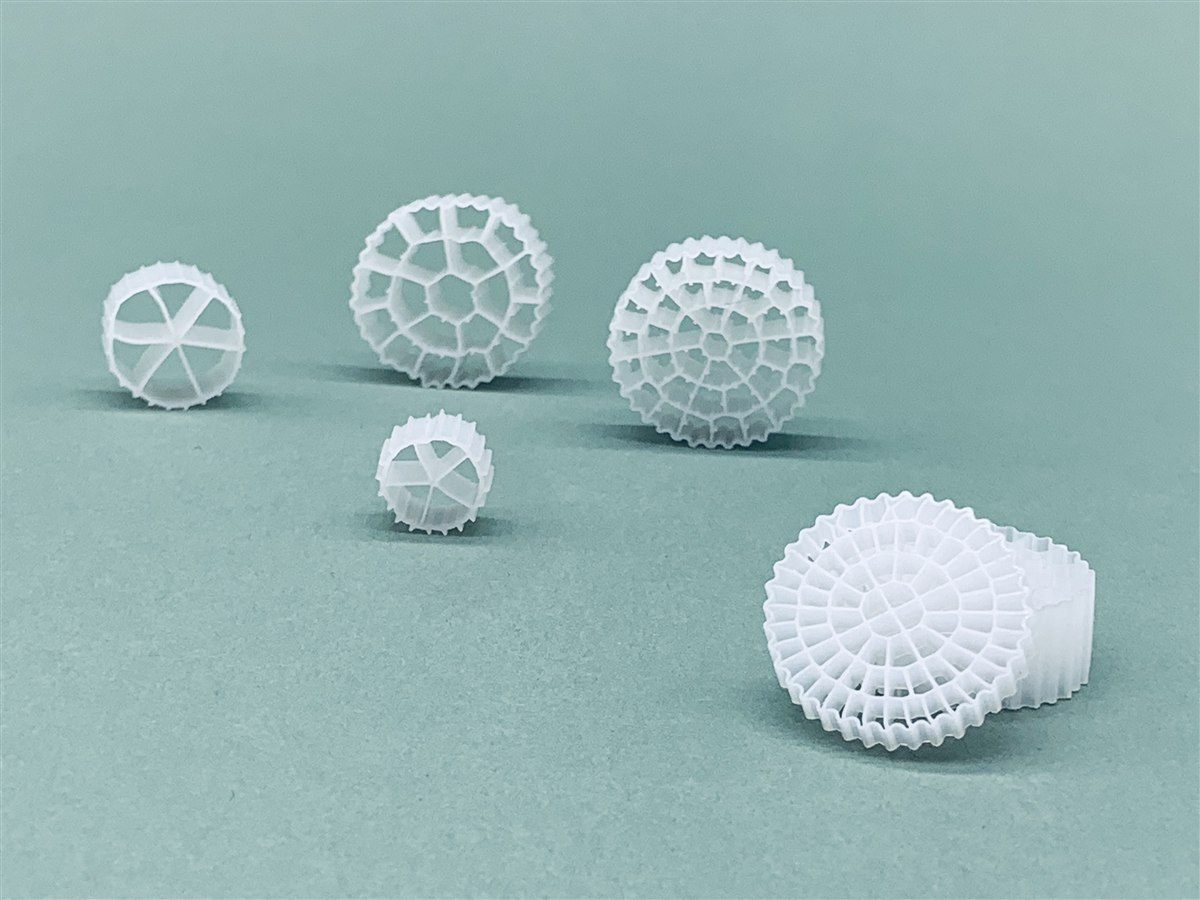
MBBR (moving bed biofilm reactor) media use the MBBR process, combining the advantages of traditional fixed-bed and fluidised-bed technologies into a highly efficient biological treatment process. A measured amount of suspended carrier is added to the reactor; on the protected area of the carrier a dense biological film grows and micro-organisms attach. Each carrier is a micro-reactor — inside the biofilm there are aerobic and anaerobic zones — and the pollutants in the water come into full contact with the biofilm and are degraded, either through aeration in aerobic tanks or agitation in anaerobic/anoxic tanks.
The media float and flow with the water, so the biofilm self-renews: after the film matures the aged film sheds and a new active film grows. The biomass concentration and the number of microbial species on the carrier are high, forming a complex ecosystem; the combined effect of the suspended activated sludge and the biofilm on the carrier greatly improves the system's load resistance, raising treatment efficiency and stabilising effluent quality.
| Model | Size / mm | Holes | Surface m²/m³ | Density g/cm³ | Pieces / m³ | Porosity % | Pieces / kg | kg / L |
|---|---|---|---|---|---|---|---|---|
| K1 | Φ10×10 | 4–5 | >800 | 0.96 | >850,000 | >85 | 2000 | 0.15 |
| K2 | Φ15×10 | 6 | >800 | 0.96 | >830,000 | >85 | 1100 | 0.13 |
| K3 | Φ25×10 | 19 | >900 | 0.96 | >76,000 | >90 | 520 | 0.10 |
| K4 | Φ25×10 | 37 | >1000 | 0.96 | >76,000 | >90 | 320 | 0.09 |
| K5 | Φ25×5 | 64 | >1000 | 0.96 | >79,000 | >90 | 500 | 0.10 |
Suggested dosing rate 15–67%; film formation 3–15 days; operating temperature 5–60 ℃; service life >15 years; nitrification 400–1200; BOD oxidation 2000–10000; COD oxidation 2000–15000.
| Model | Size / mm | Density g/cm³ | Dosing % | Nitrification gN/m³·d | Surface m²/m³ | Pieces / m³ | Material |
|---|---|---|---|---|---|---|---|
| PE01 | Φ12×9 | 0.94–0.97 | 15–70 | 400–1200 | >800 | >830,000 | HDPE |
| PE02 | Φ11×7 | 0.94–0.97 | 15–75 | 400–1200 | >900 | >830,000 | HDPE |
| PE03 | Φ10×7 | 0.94–0.97 | 15–70 | 400–1200 | >1000 | >900,000 | HDPE |
| PE04 | Φ16×10 | 0.94–0.97 | 15–67 | 400–1200 | >800 | >520,000 | HDPE |
| PE05 | Φ25×10 | 0.94–0.97 | 15–65 | 400–1200 | >800 | >118,000 | HDPE |
| PE06 | Φ25×10 | 0.94–0.97 | 15–65 | 400–1200 | >600 | >118,000 | HDPE |
| PE08 | Φ25×10 | 0.94–0.97 | 15–70 | 500–1400 | >1300 | >184,000 | HDPE |
Efficient carbon removal and superior nitrogen removal — the carrier provides a safe environment for dominant bacteria and a longer sludge age, raising nitrifier concentration; the high biological concentration damps inlet fluctuations and improves impact-load resistance. In a comparative trial treating septic-tank water (inlet COD 150–200 mg/L, NH₃-N 100–130 mg/L) with the same effective tank volume and no sludge return, two suspended-carrier systems dosed at 40% outperformed an activated-sludge process and also fixed-bed, contact-oxidation and moving-bed carriers dosed at 70% — showing higher carbon and nitrogen removal at a lower dosing rate. The biofilm process needs only adding media dosing to the existing tank, saving significantly on footprint.